

Hot work tool steel and cold work tool steel are both designed for demanding industrial applications, but they serve very different operating conditions. The main difference comes down to temperature: hot work steel is engineered to withstand elevated temperatures without softening, while cold work steel is optimized for cutting and forming at or near room temperature. Choosing the wrong type can lead to premature tool failure, dimensional instability, or excessive wear. This guide compares their service temperature ranges, chemical compositions, mechanical properties, heat treatment responses, and typical applications to help you select the right material for your tooling.
Hot Work vs Cold Work Tool Steel: Key Differences
Service Temperature Range
The most fundamental difference between these two families is the temperature at which they operate. Cold work tool steel is designed for service temperatures below 100°C (212°F), though some sources define the upper limit as 200°C (392°F). Its properties are optimized for room-temperature cutting, blanking, forming, and shearing. When temperatures rise, cold work steel begins to lose hardness and wear resistance.
Hot work tool steel, by contrast, is built for service temperatures between 350°C and 700°C (662°F to 1292°F). It is used in processes where the tool comes into contact with molten metal, hot billets, or heated dies. Hot work steel resists softening, thermal fatigue, and heat checking under these extreme conditions. Common hot work grades include H13, H11, and H21. Cold work grades include D2, A2, O1, and W1.
Chemical Composition and Alloying Elements
The alloying systems reflect their different missions.
Cold work tool steel typically contains high carbon (0.7–1.4% or higher) along with chromium, molybdenum, vanadium, and sometimes tungsten. Chromium forms hard carbides that improve wear resistance. Vanadium creates extremely hard MC-type carbides that resist abrasion. Molybdenum and tungsten provide secondary hardening during tempering. The goal is maximum hardness and wear resistance at room temperature.
Hot work tool steel usually contains lower carbon (0.3–0.6%) but higher levels of chromium, tungsten, molybdenum, and vanadium. The alloy design focuses on resistance to softening at high temperatures, thermal fatigue resistance, and toughness. Chromium provides oxidation resistance and hardenability. Tungsten and molybdenum improve hot hardness. Vanadium refines grain structure and improves resistance to heat checking.
Hardness and Heat Resistance
Cold work tool steel achieves higher room-temperature hardness. Typical cold work grades reach 58–64 HRC after heat treatment. D2, for example, can reach 62–64 HRC. This high hardness is essential for cutting and forming operations where edge retention matters.
Hot work tool steel typically achieves lower room-temperature hardness — usually 42–52 HRC. However, its advantage is that it retains much of this hardness at elevated temperatures. For instance, H13 maintains good hardness and strength even at 500°C. Cold work steel would soften rapidly at such temperatures. The trade-off is clear: cold work steel wins at room temperature; hot work steel wins in the heat.
Properties and Performance of Hot Work and Cold Work Tool Steel
Wear Resistance and Toughness
Cold work tool steel is designed for high wear resistance. The abundant hard carbides resist abrasive wear from metal-to-metal contact, mineral fillers, and hard particles. However, this high carbide content can reduce toughness. Cold work grades are generally less capable of absorbing heavy impact loads compared to hot work grades. They can chip or crack under shock loading, especially in high-carbon, high-chromium grades like D2 and D3.
Hot work tool steel offers a better balance of toughness and heat resistance. It contains fewer and finer carbides, which improves impact toughness and resistance to thermal cracking. This makes hot work steel suitable for applications involving rapid heating and cooling cycles, such as die casting and forging, where thermal fatigue and mechanical shock are common.
Dimensional Stability and Heat Treatment Response
Both families require careful heat treatment, but their responses differ.
Cold work tool steel often benefits from air-hardening grades like A2 and D2. Air hardening minimizes distortion during quenching, which is critical for precision tools. However, high-carbon grades can still experience some dimensional change. Cryogenic treatment is sometimes used to stabilize dimensions and improve wear resistance.
Hot work tool steel also responds well to controlled heat treatment. The alloying elements provide resistance to tempering, allowing the steel to retain its properties after prolonged exposure to heat. Dimensional stability at high temperatures is a key requirement for hot work dies, which must maintain precise tolerances under thermal cycling.
Applications: When to Use Hot Work or Cold Work Tool Steel
Hot Work Tool Steel Applications
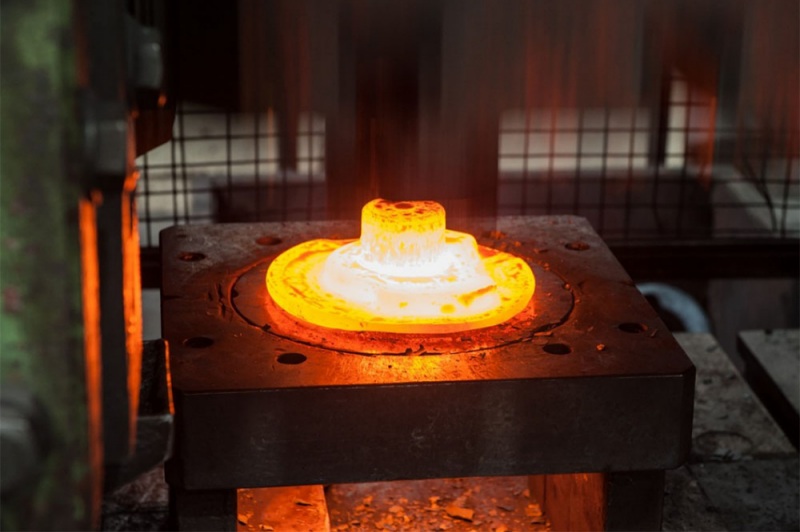
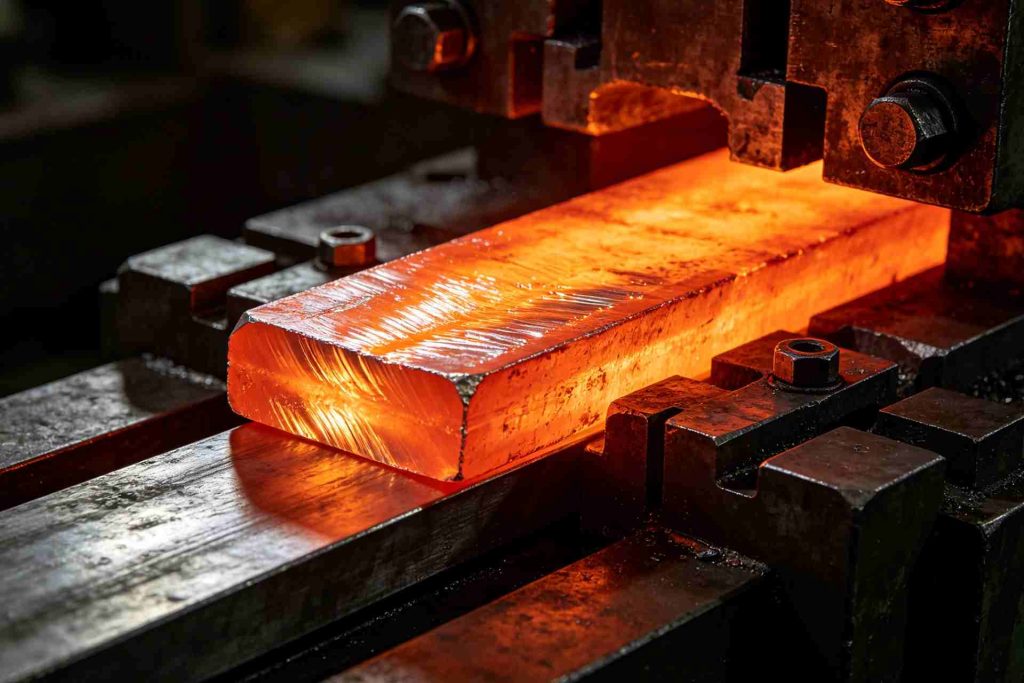
Hot work tool steel is used in processes where tools are exposed to high temperatures. Typical applications include:
- Die casting dies for aluminum, magnesium, and zinc
- Extrusion dies for aluminum and copper
- Forging dies and punches
- Hot shear blades
- Hot forming tools
- Mandrels and piercers
These tools must resist thermal fatigue, heat checking, and softening. H13 is one of the most widely used hot work grades because of its balanced combination of hot hardness, toughness, and thermal fatigue resistance.
Cold Work Tool Steel Applications
Cold work tool steel is used for cutting and forming metal at or near room temperature. Common applications include:
- Blanking dies, stamping dies, and punching tools
- Shear blades and industrial cutting knives
- Thread-rolling dies and forming rolls
- Cold forging and cold drawing tools
- Precision gauges and wear plates
These tools require high hardness and wear resistance to maintain sharp edges and dimensional accuracy over long production runs. D2, A2, and O1 are among the most common cold work grades.
Can They Be Used Interchangeably?
In most cases, no. Using cold work steel in a hot application will cause rapid softening and failure. Using hot work steel in a cold application may result in insufficient wear resistance and poor edge retention. There are limited crossover scenarios, but they require careful evaluation. For example, some hot work grades can be used for cold work if wear demands are low. However, the general rule is to match the steel family to the service temperature and wear mechanism.
When selecting tool steel, consider the full range of tool steel grades available. A reliable supplier can provide guidance on material selection, heat treatment, and application-specific performance.
FAQs About Hot Work vs Cold Work Tool Steel
What is the main difference between hot work and cold work tool steel?
The main difference is the service temperature. Cold work tool steel operates below 100–200°C and prioritizes high hardness and wear resistance at room temperature. Hot work tool steel operates between 350–700°C and is designed to resist softening, thermal fatigue, and heat checking at elevated temperatures.
Which one is harder?
Cold work tool steel is harder at room temperature, typically reaching 58–64 HRC. Hot work tool steel typically achieves 42–52 HRC. However, hot work steel maintains its hardness at high temperatures, while cold work steel loses hardness quickly when heated.
Which one is better for die casting?
Hot work tool steel is the correct choice for die casting. Die casting involves molten metal at high temperatures, and the die must withstand thermal cycling, erosion, and heat checking. Cold work steel would soften and fail rapidly under these conditions.
Which one is better for blanking and stamping?
Cold work tool steel is better for blanking and stamping. These operations are performed at room temperature and require high hardness, wear resistance, and edge retention. Grades like D2, A2, and O1 are commonly used for these applications. Hot work steel would not provide sufficient wear resistance for most blanking and stamping tasks.